

Pasted on the vibrant green walls of the culture:LAB at The Museum of Contemporary Art Grand Avenue, Los Angeles is a brief description of American Gurl: home—land. The two-channel installation brings together six multidisciplinary artists to answer the question at the heart of the exhibition: How do we re-imagine the American Dream to include the hopes, musings, and fantasies of women?
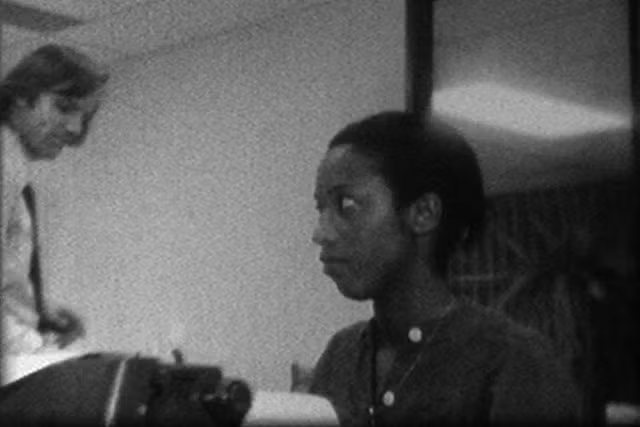
The experimental films play on a loop, with four headphones for viewers to wrap themselves in the aural and visual textures of each work. Sitting on the lightly cushioned metallic bench closest to the screens, I found myself pleasantly disoriented by the film that was playing—Melvonna Ballenger’s Rain (Nyesha) (1978). The concept of the “American Dream” traditionally conjures images of heteronormative families and white picket fences, not rainy days and escapes from the capitalist grind. However, those familiar with home—land’s curators will quickly recognize the indictments that Ballenger and the other resident artists stage in response to ideals that were created in opposition to their communities.
The American Gurl project—a multimodal, iterative collaboration between Kilo Kish and Zehra Zehra—began with the slow release of Kilo Kish’s second studio album by the same name. A campy meditation on consumerism, media culture(s), and environmental degradation, the album has found new lives following its initial rollout during summer 2021. Since its release four years ago, Kish’s work(s) for the project have been presented as immersive experiences, public performances, digital installations, and experimental cinematography. Though Kish refuses to present viewers with clear answers to her questions, one thing is for certain: the “American Dream” is a contradiction that engenders creative navigations and negotiations—social, economic, politica—by those at the margins.

It is in the interstitial spaces of (un)freedom and be/longing that the artists assembled for home—land dare to dream otherwise. Extending the key concepts of the American Gurl project, this exhibition brings together women and femmes from across the African diaspora as they ruminate on what form(s) dreaming might take if we were to center their perspectives. A deformance of sorts, American-ness is rendered increasingly unrecognizable throughout the films, consumed and subsequently transformed by “the hopes, musings, and fantasies” of the artists. Rather than simply repurposing Americana aesthetics to speak of contemporary Black life, the project challenges the meaning(s) of “America”—as history, culture, place—altogether.1
Where Rain (Nyesha) opens a portal to Black worlds through its multisensory engagements with water—most notably her evocation of John Coltrane’s “After the Rain”—hija de Florinda (Los Angeles and Morell, 2024) and Shakersss.mov (Solange Knowles, 2025) enter that portal via Black spiritual (re)imaginings of the American Dream. A poetic meditation on the devastating impacts of climate catastrophe on Black Dominican body-lands, hija de Florinda presents intergenerational wisdom and ancestral knowledge (i.e., conjuring farmer, activist, and ancestor Mamá Tingó through rare archival footage) as rehearsals for surviving the present.2 Similarly, Shakersss.mov uses VHS film to mirror the quality and texture of home movies, presenting an intimate portrait of Knowles as she performs rituals—to self, God, Yemanya—in private and the company of friends. The various iterations of water that appear throughout these films—rain, wetlands, hot tubs—reconceptualize the American Dream by thinking Blackness beyond the Transatlantic slave trade. While the artists do not shy away from the racial politics of their respective times and places, they remind viewers of all that Blackness is/was/can become if we dare to dream more expansively.

Alima Lee’s The Siren’s Lament (2025) and Triangle Trade by Cauleen Smith (2017) offer surreal approaches to the Black Atlantic histories hinted at in the previous films. Staged as a siren’s wrath on the thirteen colonies and a creation story at the limit of a no-longer recognizable world, respectively, these films stretch the imagination to consider what might be said/done in response to the legacies of colonial violence that continue to haunt Black folks in the present. Where both films use techniques that lay in stark contrast with the severity of their shared theme—The Siren’s Lament’s mixture of colonial and medieval aesthetics, Triangle Trade’s use of crafts and puppetry—Ella Ezeike’s Words We Don’t Say (2022) returns to the interpersonal to give new textures to diasporic dreaming. An intimate portrait of a father-daughter relationship, the film calls the viewer to look inward and consider their own negotiations of imperfect relationships. The film abandons tropes of the broken Black family to reflect instead on how we see/hear/feel one another—as Black folks caught in the middle of expired promises and fleeting freedoms—in ways that offer more grace and compassion than the ever-elusive American Dream might offer. As the latest in the American Gurl series, home—land imagines what might come after the American Dream. Rather than tasking Black women and femmes with saving us from the social, economic, political, and environmental decay of our current moment, the exhibition calls viewers to witness how the artists and their collaborators have dared to keep dreaming in an otherwise untenable present. Different from voyeurism and surveillance—tools leveraged to quell and control Black communities past and present—witnessing is an active practice that speaks with rather than for those at the margins. As witnesses to the work and lives of these multidisciplinary artists, I encourage audiences to ask themselves: How might I honor and make way for the hopes, musings, and fantasies of Black women and femmes?
- “American” is used here as per Variable West’s style guide. ↩︎
- Body-lands is a concept—developed by Black Dominican writer and scholar Ana-Maurine Lara—to describe the “co-constructions of bodies and the lands across/through/on which those bodies exist” (2020, p. 61)
↩︎
culture:LAB: Womxn in Windows / American Gurl: home—land
MOCA Grand, Los Angeles, CA
February 4 – March 9, 2025